
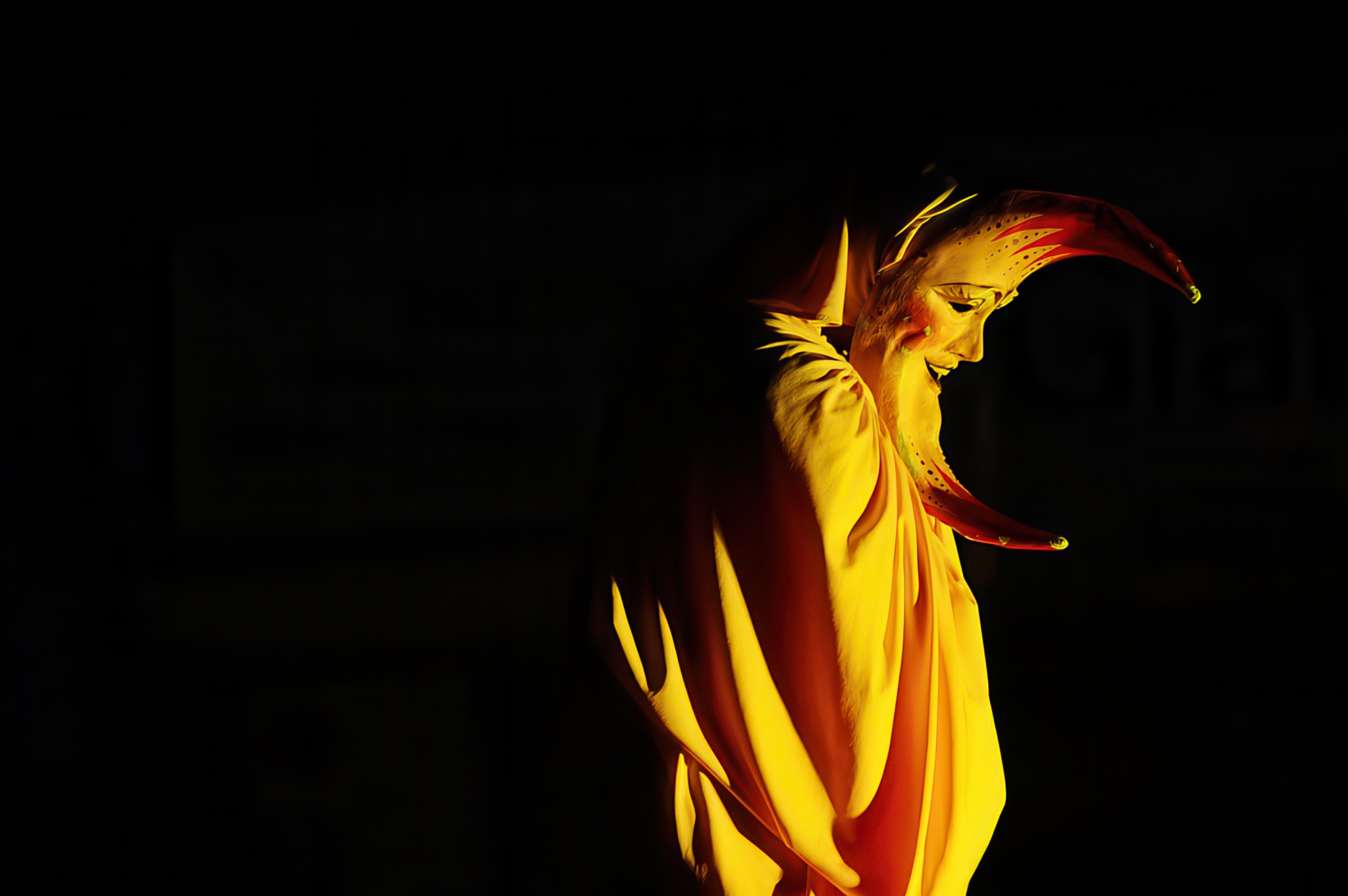
The mask. A simple object, yet one so full of mystery.
Since the earliest times, it has fascinated humanity with its ability to transform, conceal, and reveal. It is as if, the moment someone puts it on, the world around them changes.
You are no longer simply yourself: you become something else, take on a different identity, and move through a realm where ordinary rules no longer apply.
But why did humans feel the need to create and wear masks? The answer is lost in the folds of history.
The Mask in the Antiquity
Imagine a prehistoric man, surrounded by the dancing fire of his tribe, covering his face with a stone mask. He is no longer merely a man: he becomes a spirit, an ancestor, a god walking upon the earth. The oldest masks known to us date back thousands of years, carved from stone and preserved through time as silent witnesses to rituals long forgotten. Yet their purpose was clear: to summon the supernatural, to open a doorway into a world that cannot be seen with ordinary eyes.

There is something deeply fascinating about this ambiguity of the mask. On the one hand, it protects the wearer, allowing them to hide, to become someone or something else. On the other, it unsettles the observer: who is behind it? What face lies beneath that false smile, beneath that carved grimace? It is precisely this duality that gives the mask its power, enabling it to fascinate and frighten at the same time.
In the course of history, the mask was a bridge between men and the gods. At the Dogon, for example, the masks were not mere objects, but incarnations of the ancestral strengths, tools to maintain the balance between the world of the living and that of the spirits. The shamans of the inuit used them for travel in the afterlife, to speak with the souls of the animals and re-establish harmony with nature. Wear a mask meant to not only change the look, but to make a journey, to abandon the self to become something bigger.
Then there is theatre. Here, the mask becomes a universal language. In ancient Greece, actors wore enormous masks with wide-open mouths that amplified the voice and allowed the audience to immediately recognize the character. The Latin term "persona" referred both to the mask and to the role being played: you were no longer a man, but a symbol, a story embodied.

The Mask in the Commedia dell’Arte
But if there is one moment when the mask reached the fullest expression of its theatrical power, it was with Commedia dell'Arte. Imagine an actor who, with a simple gesture, puts on a leather mask: in an instant, he becomes Arlecchino, Pantalone, Pulcinella. The mask is not merely a disguise, but a true code of movement, a way of being. Every gesture, every tilt of the body, every tone of voice is guided by that rigid object covering the face which, paradoxically, frees the actor from the need to perform with facial expressions, pushing him to express himself with the rest of the body.

And yet, the mask has not always been viewed favorably. With the rise of monotheistic religions, many masked traditions came to be regarded as dangerous, deceptive, even demonic. Carnival, with its grotesque figures and its subversion of social rules, was tolerated only as a release before Lent.
But the truth is that the mask never truly surrendered. It continued to exist, to evolve, to change shape without ever losing its power.
Perhaps this is precisely its secret: the ability to adapt, to always be different and yet always the same. Because ultimately, the mask is a reflection of the human being, of our desire to play with identity, to explore the boundary between reality and fiction, between the visible and the invisible. Every time we wear one, even only metaphorically, we are performing an act as ancient as humanity itself. We are becoming something else, rediscovering parts of ourselves that, without that mask, we might never have had the courage to reveal.
