
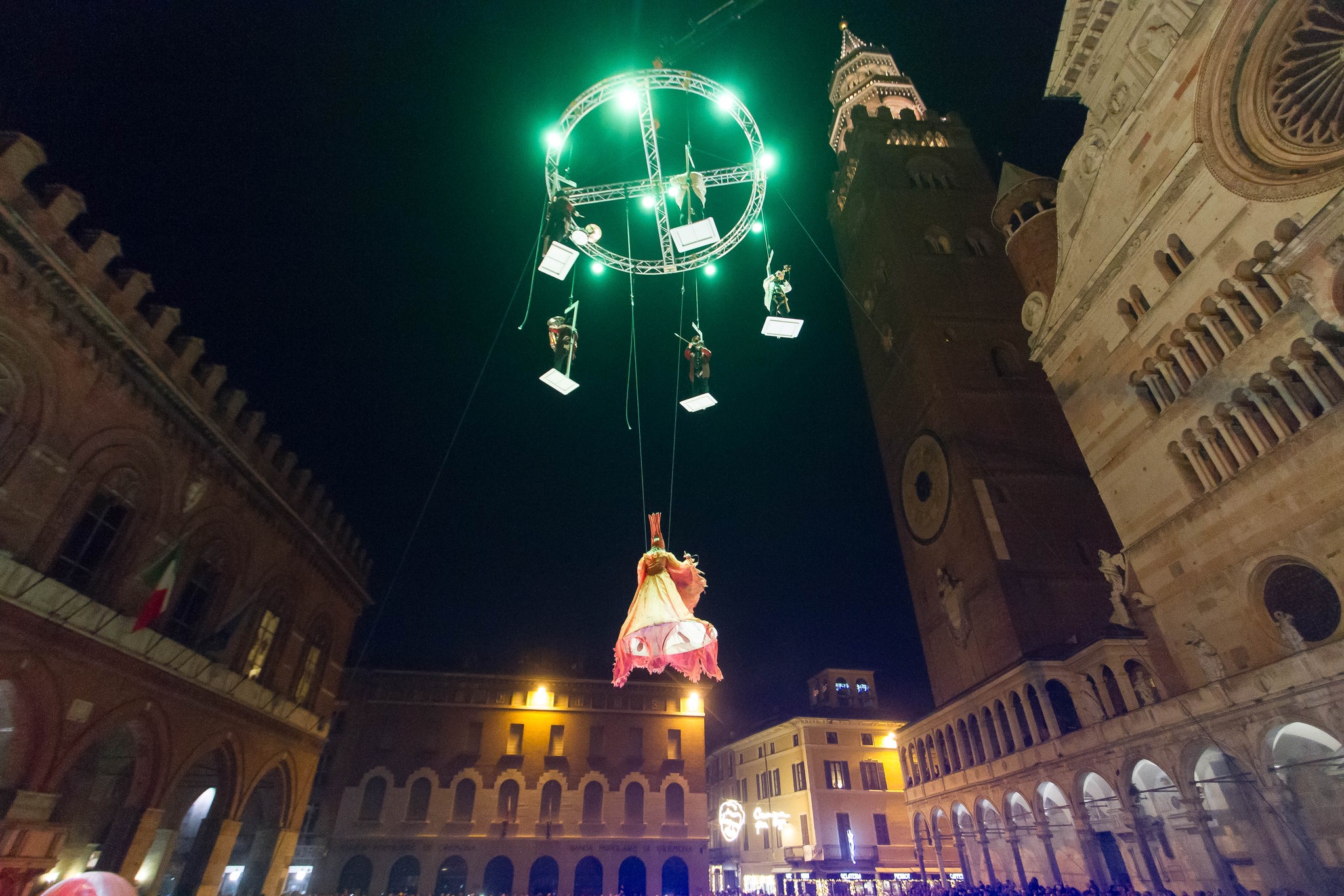
When we think of theatre, the image that immediately comes to mind is often that of a curtain opening, a lit stage and an audience seated in the stalls. Yet there is a form of performance that is born outside theatre buildings and chooses squares, streets and the places people pass through every day as its stage. The history of street theatre is precisely the story of this direct encounter between artist, urban space and audience.
In street theatre, the artist does not wait for the spectator to enter a venue. Instead, the artist goes out to meet them, surprising them as they cross a square, walk down an alley or stop at a market. The performance is born in the heart of the city and, even if only for a few minutes, transforms an everyday place into a space for imagination.
The origins of street theatre
The roots of street theatre are very ancient. Even in past civilisations, forms of performance animated markets, celebrations and public spaces through storytelling, music, juggling and physical performance.
During the Middle Ages, it was above all jesters, acrobats, musicians and storytellers who brought entertainment among the people. Squares and fairs became places where storytelling mixed with satire, music, acrobatics and improvisation. These popular performers often lived on the margins of institutions, but precisely for this reason they maintained an especially direct relationship with their audiences.
Over the centuries, theatre increasingly found a home inside dedicated buildings and venues, but the tradition of travelling performance did not disappear. It continued through touring companies and popular forms capable of bringing theatre even to places without a theatre building.
The history of street theatre has therefore, from its very beginnings, been linked to the artist’s ability to adapt to a space and create a performance using whatever the location has to offer.
The contemporary revival
In the twentieth century, particularly during the 1970s and 1980s, street theatre entered a new phase. Many artists and companies once again deliberately chose the square as a place for creation and encounter.
Urban space was no longer seen merely as an alternative to traditional theatre, but became an integral part of the performance itself. The street offered a different kind of freedom: it made it possible to reach people who might never have entered a theatre and allowed artists to experiment with new languages.
In those years, festivals, companies and projects emerged that helped redefine the relationship between the performing arts and public space. Fire, stilts, music, acrobatics, physical theatre and large-scale scenic installations gradually became part of the language of contemporary street theatre.
The city becomes the stage
One of the most fascinating features of street theatre is its ability to transform the city itself into a performance space.
A façade can become the backdrop to a performance, a staircase can turn into a natural auditorium, an alley can become the route of a parade and a square can take on the appearance of a large open-air theatre for an evening.
There is therefore no clear separation between scenery and surroundings. Architecture, light, people and even the sounds of the city become part of the performance.
A statement connected with the Ferrara Buskers Festival captures this idea well:
The city is our theatre: the stones are our scenery and the people are our curtain.
It is precisely this relationship with the place that makes every performance different from the one before it.
The direct relationship with the audience
In street theatre, the relationship between artist and spectator also changes profoundly.
The audience is not necessarily positioned in front of a stage. It often forms spontaneously around the performers, creating what is traditionally known as the “circle”. It is a simple performance space, shaped by the very presence of the people themselves.
There are no seats, boxes or sections. Spectators may arrive after the performance has already begun, stop out of curiosity and become part of what is happening.
Street theatre therefore has a deeply participatory dimension. Applause, laughter, unexpected reactions and interactions become part of the performance and continually change its rhythm.
In some traditional forms, the practice of performing “for the hat” still survives, with the audience freely choosing whether to reward the artist at the end of the performance.
Improvisation and the uniqueness of every performance
The street is not a controllable space like a theatre.
A car may pass by, a bell may ring, a child may cross the performance space or a passer-by may unexpectedly become the protagonist of a scene. The artist must be able to embrace the unexpected and transform it into part of the performance.
For this reason, improvisation is one of the fundamental elements of street theatre.
Every place has a different atmosphere and every audience reacts differently. Even a performance built around a precise structure inevitably changes each time it is presented.
It is precisely this fragility, this balance between planning and the unexpected, that makes street theatre a unique and unrepeatable experience.
From street theatre to Arte Celeste
Over time, street theatre has continued to expand its expressive languages. One of its most spectacular developments is connected with aerial performance.
The Compagnia dei Folli has chosen to define this artistic research by the name Celestial Art.
The principle is to gradually move the performance space from the ground towards the sky. Aerial silks, hoops, trapezes, ropes, suspended structures, cranes and hot-air balloons allow performers to create choreographies in which the audience no longer looks only straight ahead, but is invited to raise its gaze.
Acrobatics thus becomes part of a visual narrative. The sky becomes the scenery, and verticality completely changes the relationship between performer, architecture and spectator.
Arte Celeste therefore emerges from the encounter between street theatre, acrobatics and imagination: a language in which suspended movement becomes storytelling.
Street theatre, city and community
The history of street theatre is not only about the evolution of an art form. It is also about the way performance can temporarily change how public spaces are perceived.
A square crossed absent-mindedly every day can become a meeting place. A building can be seen from a completely different perspective. A historic town centre can be transformed into a shared performance space.
Street theatre creates community precisely because it brings together very different people without asking them to enter a specific venue. The performance comes directly into public space and makes art accessible to anyone who happens to pass by.
In this sense, it is not only a form of entertainment, but also a means of enhancing places and contributing to the cultural regeneration of urban space.
Over time, France has developed strong support for street arts, while in Italy organisations such as FNAS e ANAP have worked for the recognition and growth of the sector. Since 2005, street theatre has also been included in the Italian National Fund for the Performing Arts.
Contemporary street theatre
Today, the boundaries of street theatre are broader than ever.
Alongside the traditions of juggling, clowning and acrobatics, contemporary circus, urban dance, physical theatre, large-scale scenic machinery, video projections, digital technologies and aerial performances have all become part of the form.
The street, however, continues to preserve its fundamental characteristic: it is a space where art meets everyday life directly.
TheArte Celeste of Compagnia dei Folli also stems from this idea. Taking performance outside conventional venues means being able to transform a square, a building or even the sky into a place in which to tell a story.
A story still in motion
Telling the history of street theatre means telling the story of an art form that has never stopped transforming.
From the jesters of the squares to major contemporary productions, from spontaneous performances to acts suspended dozens of metres above the ground, one fundamental principle has remained unchanged: creating an encounter.
Street theatre exists in the moment when an artist manages, for a few instants, to interrupt the everyday rhythm of the city and turn a passer-by into a spectator.
Perhaps this is its deepest strength: reminding us that art does not belong only to places built to host it. It can be born in a square, cross a street, climb the façade of a building or rise into the sky.
And when this happens, even the most familiar place can become a theatre for a few moments.